
Odour control is an important part of maintaining acceptable indoor and industrial air quality. Unpleasant smells are often more than a comfort issue because the compounds responsible for odours can originate from chemical processes, wastewater, waste handling, food processing, animal research, and other industrial activities. Depending on the source, contaminated air may contain sulphur compounds, ammonia, volatile organic compounds, amines, aldehydes, ketones, or other gaseous pollutants.
Effective odour management therefore requires more than masking unpleasant smells with fragrances or conventional air fresheners. The source and composition of the contaminated air need to be understood so that an appropriate treatment method can be selected. Bry-Air develops gas phase filtration and environmental control technologies, including systems designed to remove gaseous contaminants and odour-causing compounds from air.
An appropriately selected odour control units can help treat contaminated air by combining particulate filtration with chemical filtration technologies. Bry-Air’s odour control approach uses adsorption and chemisorption to capture or neutralize gaseous contaminants, helping create cleaner air in environments where conventional particulate filtration alone may not be sufficient.
Why Is Odour Control Important for Air Quality?
Odours are produced when airborne chemical compounds reach the human sense of smell at detectable concentrations. Different processes can generate different mixtures of compounds, meaning that the appropriate control strategy depends on the source and characteristics of the contaminated air.
Bry-Air identifies waste management facilities, sewage treatment plants, agricultural operations, industrial processes, food processing, chemical and petrochemical operations, and other environments as potential sources of odour pollution. The company also notes that odorous substances may include organic and inorganic sulphide compounds, nitrogen compounds, halogenated compounds, ammonia, and volatile organic compounds.
Can Odorous Gases Affect People and Equipment?
Persistent unpleasant odours can affect comfort and perceived indoor environmental quality. Bry-Air notes that strong or offensive odours may be associated with headaches, nausea, respiratory irritation, stress, and reduced quality of life. The effects depend on the specific substances present, their concentrations, exposure duration, and individual sensitivity.
Odorous or corrosive gases can also affect equipment. Certain airborne contaminants may interact with sensitive components, accelerate corrosion, or interfere with sensors and electronic equipment. This makes gas phase filtration relevant not only to human comfort but also to the protection of equipment operating in contaminated environments.
How Do Odour Control Systems Remove Gaseous Contaminants?
Odour control requires a treatment process capable of addressing gaseous contaminants rather than only airborne particles. Conventional particulate filters can capture dust and other suspended particles, but they are not designed to remove every gaseous compound responsible for odour.
Bry-Air’s odour control technology combines filtration and chemical media to address these contaminants. Its systems use adsorption and chemisorption processes, allowing gaseous molecules to interact with specially selected chemical media as contaminated air passes through the filtration stages.
What Is the Role of Adsorption?
Adsorption occurs when molecules from a gas stream are captured on the surface of a solid material. Activated carbon is widely used in gas phase filtration because of its porous structure and large internal surface area. Depending on the contaminant, different adsorbent materials and treatment media may be required.
The selection of filtration media should therefore be based on the type and concentration of contaminants present in the air. A media suitable for one gaseous compound may not provide the same performance against another. Proper system engineering should consider contaminant chemistry, airflow, concentration, temperature, humidity, and required removal performance.
How Does Chemisorption Work?
Chemisorption involves a chemical reaction between the contaminant and an active substance within the filtration media. Rather than simply retaining a molecule on a surface, the process can chemically react with targeted gaseous compounds.
Bry-Air’s odour control units use chemical media that can include activated carbon and activated alumina impregnated with proprietary chemicals. The company explains that these media are used to neutralize gaseous contaminants through adsorption and chemisorption.
This combination can be useful when the air contains compounds that require more than simple physical adsorption. However, the appropriate media configuration should always be determined from the actual contaminant profile and application conditions.
What Should Be Considered When Selecting an Odour Control System?
Selecting an odour treatment system requires a technical assessment of the contaminated air rather than relying only on the intensity of the smell. Odour perception does not necessarily provide enough information to identify the chemical composition or concentration of the contaminants.
Important design parameters include airflow volume, contaminant type, contaminant concentration, temperature, relative humidity, available installation space, required removal efficiency, and expected filter or media life.
Why Is Airflow Important?
Airflow is one of the fundamental parameters in gas phase filtration. The filtration system needs to handle the required quantity of contaminated air while providing sufficient contact between the air stream and the treatment media.
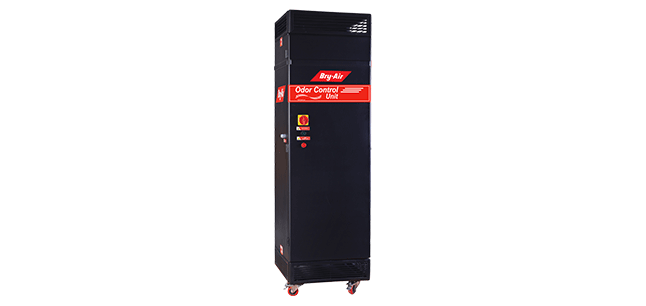
Bry-Air offers a honeycomb chemical filter based odour control system with stated airflow capacities ranging from 500 CFM to 2,000 CFM.
Actual equipment selection should be based on the application’s airflow requirement and contaminant characteristics. Oversizing or undersizing a system can affect equipment economics, pressure drop, filtration performance, and media utilization.
Why Does Contaminant Identification Matter?
Different gases have different chemical properties, and filtration media are not universally effective against every contaminant. For example, ammonia, hydrogen sulphide, sulphur compounds, volatile organic compounds, and acidic gases may require different treatment approaches.
Bry-Air’s industry information identifies different odour-producing substances across sectors, including ammonia in food processing and livestock environments and hydrogen sulphide in food processing, livestock facilities, paper mills, and landfills.
This reinforces the importance of identifying the contaminants before selecting a filtration system. Where possible, air sampling and contaminant analysis should form part of the engineering assessment.
Where Can Odour Control Technology Be Used?
Odour control technology can be applied in environments where gaseous contaminants create air quality concerns. The appropriate configuration depends on the source of the contamination and the nature of the air that needs to be treated.
Bry-Air identifies applications involving animal research laboratories, mortuaries, sewage pumping stations, food processing plants, wastewater environments, and other locations where foul-smelling or potentially harmful gases can be present.
How Does It Apply to Food Processing?
Food processing operations can generate odours through fermentation, cooking, processing, decomposition, and the handling of organic materials. Bry-Air notes that food processing odours can contain aldehydes, ketones, alcohols, acids, ammonia, amines, mercaptans, and other compounds depending on the specific process.
The company recommends addressing odour at the source wherever possible through appropriate process control and housekeeping. Where contaminated air must be discharged or ventilation air needs treatment, gas phase filtration can provide an additional control measure.
How Can It Support Wastewater and Sewage Environments?
Wastewater treatment and sewage handling can produce strong odours because of the biological and chemical processes involved. Compounds such as hydrogen sulphide and other sulphur-containing gases may contribute significantly to unpleasant odours.
Odour treatment in these environments requires consideration of both the source and the ventilation system. Capturing contaminated air effectively is an important first step because filtration performance depends on bringing the contaminated air stream into contact with the treatment system.
How Does an Odour Control Unit Differ From a Conventional Air Purifier?
A conventional air purifier is generally designed around the removal of particulate contaminants such as dust, pollen, and other suspended particles. While some air purifiers incorporate activated carbon, their design and treatment capacity may not be appropriate for industrial gaseous contamination.
Bry-Air specifically distinguishes its odour control technology by its ability to address gaseous pollutants in addition to particulate contaminants. Its odour control unit uses pre-filtration followed by chemical media designed to treat gaseous contaminants.
Why Is Gas Phase Filtration Important?
Gaseous contaminants can pass through conventional particulate filtration because their molecular size and physical characteristics differ significantly from suspended particles. Gas phase filtration uses specialized media to interact with these molecules.
This makes gas phase filtration an important component of air treatment where the primary concern involves chemical gases rather than only particulate pollution. The system should still be designed around the actual contaminant profile because filtration media have specific adsorption and reaction characteristics.
What Maintenance Factors Should Be Considered?
The performance of a gas phase filtration system depends not only on the initial equipment selection but also on the condition of its filtration media. Over time, adsorption capacity can decrease as the media captures contaminants.
How Does Filter Media Life Affect Performance?
Media life depends on several factors, including contaminant concentration, airflow, operating hours, humidity, temperature, and the chemical properties of the contaminants. A system operating continuously with a high contaminant load can consume media capacity more quickly than a system operating intermittently under lower contaminant concentrations.
Regular monitoring and maintenance can help identify when filtration media require replacement. Maintenance planning should be established according to the manufacturer’s recommendations and actual operating conditions.
Why Is Preventive Maintenance Important?
Preventive maintenance helps ensure that airflow, filtration stages, seals, fans, and chemical media continue to operate as intended. Pressure drop monitoring can also provide useful information about filter loading and system condition.
A maintenance program should include inspection of pre-filters and gas phase media, checking airflow performance, reviewing operating conditions, and replacing consumable components when required. Proper maintenance supports consistent filtration performance and can help prevent unexpected interruptions.
Conclusion
Effective odour control requires a technical understanding of the contaminants present in an air stream and the conditions under which the filtration system will operate. Simply masking an unpleasant smell does not address the gaseous compounds responsible for it. A properly engineered gas phase filtration system can instead capture or chemically neutralize targeted contaminants.
Bry-Air’s odour control technology combines particulate pre-filtration with chemical media and uses adsorption and chemisorption to treat gaseous pollutants. The technology is designed for applications where odour and gaseous contamination can affect air quality, human comfort, equipment reliability, or the surrounding environment.
The right system should be selected after evaluating airflow, contaminant type and concentration, temperature, humidity, installation requirements, and expected media life. A technical assessment can help determine the appropriate filtration configuration and operating requirements. Organizations looking for application-specific guidance can Contact Us to discuss their odour control and gas phase filtration requirements.